
PHA-based filament reinforced with hemp yields a viable, sustainable, high-performance feedstock for fused deposition modeling
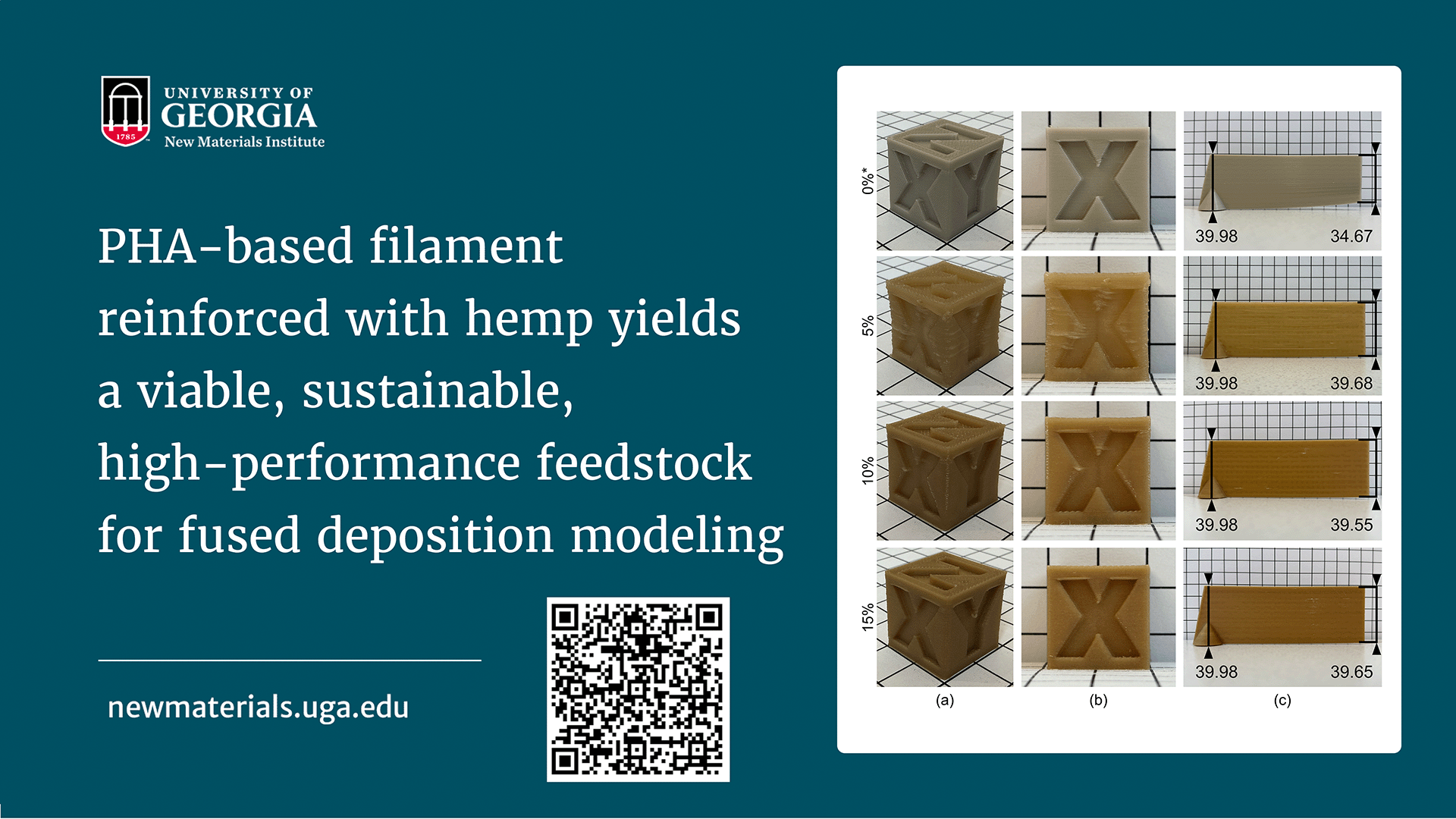
As the consumption of filaments used in 3D printing increases, so does the plastic waste. A recent study from a team based in the University of Georgia New Materials Institute examined hemp hurd fibers as reinforcement for polyhydroxyalkanoate-based composites, investigating their development, processing behavior, and printability in additive manufacturing, specifically fused deposition modeling, to create a biologically degradable filament.
Currently, among the most prevalent filaments used in FDM, all are fossil-based except poly(lactic acid), or PLA , which is bio-based but typically requires controlled industrial composting conditions to degrade. Research for sustainable alternatives has mostly focused on neat polymers. While fully biologically degradable in multiple environments, including marine, PHAs are challenging in additive manufacturing due to their narrow thermal processing windows and semi-crystalline nature which introduces severe dimensional instability during printing, known as warping.
Previous studies from UGA NMI researchers on non-toxic filament for 3d printing
To remedy these challenges, the team inserted hemp hurd fibers into the thermoplastic matrices of a poly(3-hydroxybutyrate-co-3-hydroxyhexanoate), or PHB-co–HHx, developed by the Locklin Group at the UGA NMI, comparing their output to a commercially available PHA filament. Hemp hurd is abundant in agricultural waste streams, rich in cellulose and hemicellulose, and contains up to 20-25% lignin, but incorporating it into hydrophobic thermoplastic matrices can be challenging. Lignocellulosic particulates can reduce material cost, enhance stiffness, and modulate crystallization behavior, but a gap exists in understanding how these reinforcements impact the thermal processing window, warping, and mechanical performance of 3D-printed parts. This study focused on closing these knowledge gaps.
A viable, high-performance option
The researchers found they could overcome manufacturing challenges by loading hemp into the PHB-co-HHX polymer matrix at 10 and 15 wt%, using extrusion for compounding. Produced samples were characterized by gel permeation chromatography, differential scanning calorimetry, scanning electron microscopy, polarized optical microscopy, and tensile testing. Moreover, developed composites were also evaluated for their 3D printability: warping was drastically reduced from 13% in the commercially available filament to below 1%. Their results positions hemp-reinforced PHA as a viable, high-performance, and truly biologically degradable feedstock for next-generation additive manufacturing.
“Sustainable PHA‑based filaments for FDM: Exceptional dimensional stability and reduced warpage” was coauthored by Artem Sulimov, Matthew L. Sheahan, M. Taylor Sobczak, Grant H. Crane, Branson W. Ritchie, Kenan Song and Jason Locklin. It was recently published in MRS Communications’ Advances in Additive Manufacturing: Materials, Sustainability, and Design Research Letter. Click here to read the study.
—Story by Leighton Dancy