
Creating poly(butylene succinate)-based biocomposites with switchgrass, poplar biomass for 3D printing, injection molding

The processing strategy
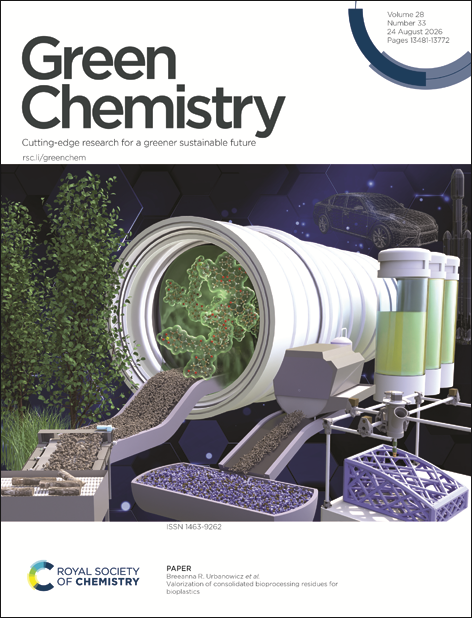
Using high-shear homogenization as a processing strategy, researchers valorized consolidated bioprocessing residues from switchgrass and poplar biomass into functional poly(butylene succinate), or PBS. Their process, documented in a recent publication, eliminated the use of organic solvents and incorporated renewable plant-derived feedstocks from waste streams, while also addressing several common manufacturing challenges. Their processing strategy is broadly applicable to other industrial plastics and composite formulations.
Consolidated bioprocessing integrates biomass saccharification and fermentation into one step while physically altering the residual material to make it finer—an advantage for effective blending of the polymer matrix. Selectively removing carbohydrates leaves a lignin-rich residue, lowering hydrophilicity of the biomass and mitigating moisture-related processing and mechanical performance issues in thermoplastic composites. Utilizing the physical force generated through HSH, the team created highly uniform composites with thermomechanical properties compatible for applications in injection molding and 3D printing.
Injection molding, 3D printing
At 30 wt% homogenized residues, the thermochemical properties of the composite were significantly enhanced, supporting use of the material for injection molding and 3D printing. During testing, the composite performed with increased stability and interlayer adhesion compared to neat PBS.
The team also performed a technoeconomic analysis and life cycle assessment to gauge the impact on ethanol selling price and global warming potential of producing composite materials from CBP residuals. They found capital equipment costs to be the biggest driver of production costs, and that increasing solids content during processing decreases equipment capacity requirements and associated costs—thus, incorporating CBP residuals in composite production can lower production costs of biocomposites.
Read the study
“Valorization of Consolidated Bioprocessing Residues for Bioplastics” was coauthored by Nataraja S. Yadavalli, Mohammad Aghajohari, Neal N. Hengge, Daniel C. Josey, Jacob Dempsey, Jacob K. Kenny, Bruno C. Klein, Rebecca J. Hanes, Evert K. Holwerda, Yannick J. Bomble, Kush G. Patel, Jason J. Locklin, Sergiy Minko and Breeanna R. Urbanowicz. The study was published in the Royal Society of Chemistry’s Green Chemistry journal. Coauthors Yadavalli, Aghajohari and Josey are in the Urbanowicz Laboratory in the UGA Complex Carbohydrate Research Center. Locklin, Urbanowicz and Minko are faculty in the UGA New Materials Institute. Coauthors Hengge, Dempsey, Kenny, Klein, Hanes and Bomble are in the National Laboratory of the Rockies for the U.S. Department of Energy. Holwerda is a research scientist in the Thayer School of Engineering at Dartmouth College.
This work was authored in part by the NLR. Funding was provided by the Center for Bioenergy Innovation, at Oak Ridge National Laboratory, supported by the U.S. Department of Energy, Office of Science, Biological and Environmental Research under Contract Number ERKP886.
—Written by Leighton Dancy