
Student Profile: Shariful Islam Tushar
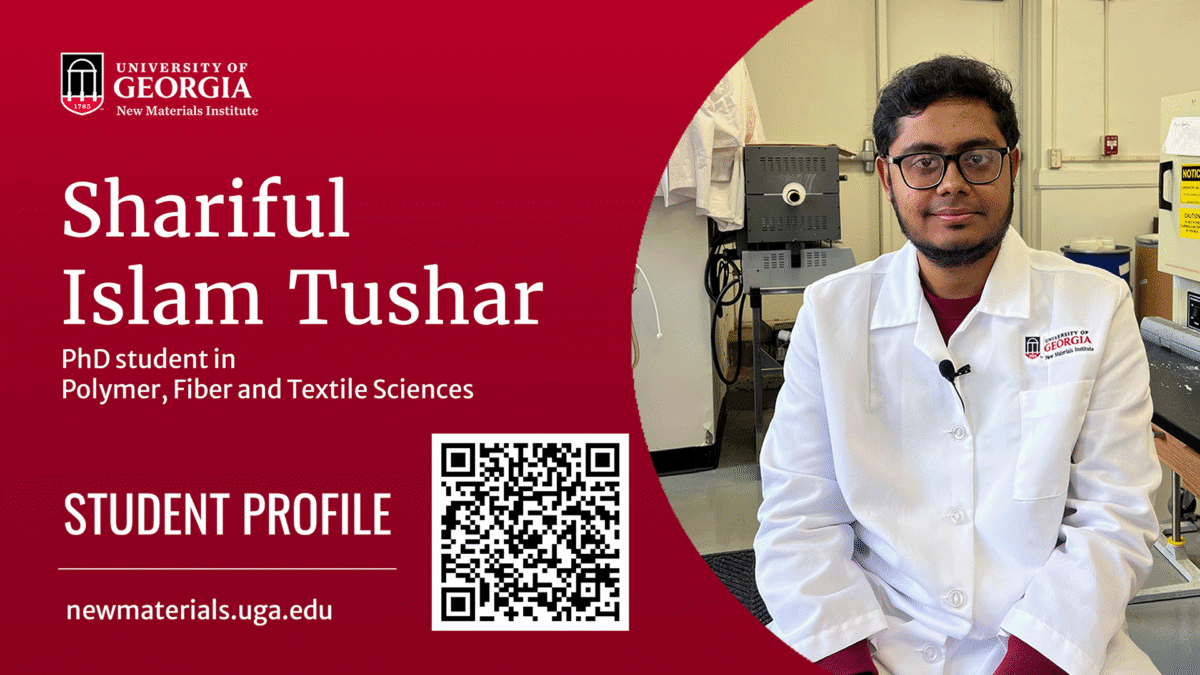
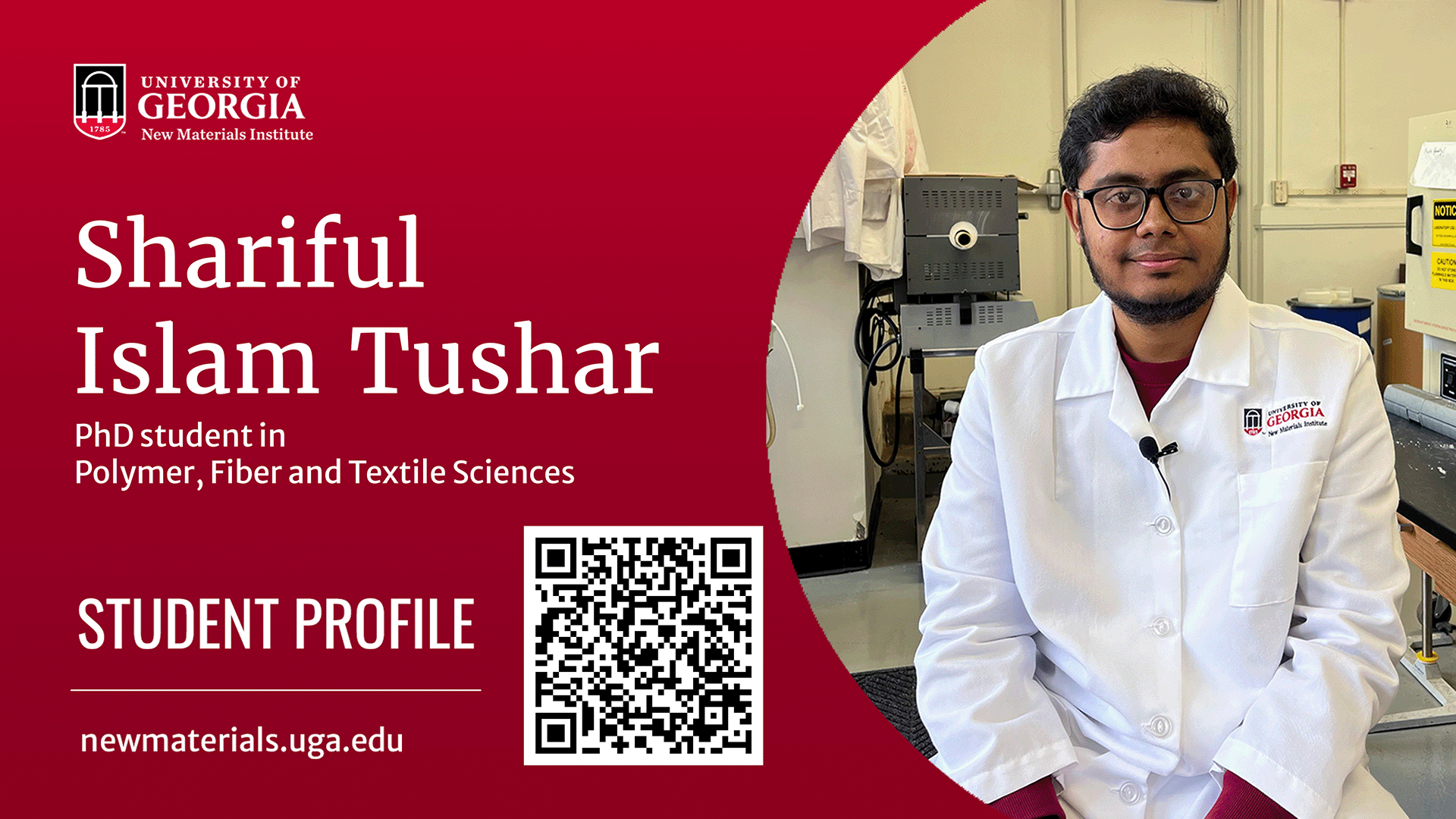
Shariful Islam Tushar is a PhD student studying development of sustainable alternatives to traditional plastics, textiles and materials. In 2024, Tushar received the UGA Presidential Graduate Fellow Award, the university’s most prestigious award for incoming doctoral students, in recognition of his outstanding scholarship and potential for success in his chosen field; the supplemental award is granted for four years.
His mentor is Suraj Sharma, a professor of polymer, fiber, and textile sciences based in the University of Georgia College of Family and Consumer Sciences; Dr. Sharma is also a faculty member in the UGA New Materials Institute.
Tushar’s research is focused on designing and engineering bio-based soft materials, including films, aerogels, foams, hydrogels, and functional textiles. One of his projects involves developing sustainable packaging alternatives using biopolyester and nanofibrillated cellulose (NFC)–based coatings. This work includes developing barrier coatings and laminated films using nanocellulose and biopolymer dispersions, engineered to control moisture, oxygen, and grease barrier performance in sustainable packaging applications. In parallel, he is working on green, bio-based aerogels, which are lightweight, foam-like porous materials tailored with nanopore structures and ultralow density for applications in thermal insulation, sound absorption, air filtration, and superabsorbent systems. Tushar’s work is conducted in Sharma’s laboratory with colleagues, known as the Innovative Materials Research Team.
How did you become interested in studying materials science?
My interest in materials science grew from seeing how everyday materials are designed for performance and cost, often without considering their environmental impact of end-of-life. I began my academic training in textile engineering, where I became fascinated by how material structure—from the nano- to the micro-scale—controls properties such as heat transfer, moisture transport, and barrier performance.
As I progressed into research, I became particularly interested in developing sustainable alternatives to petroleum-based, single-use materials. Working with nanocellulose, biopolymers, and porous systems showed me how thoughtful material design can reduce waste while maintaining functionality. These experiences made it clear that materials science is a powerful tool for addressing global challenges like pollution and resource inefficiency by redesigning materials at the source.
This perspective led me to pursue a PhD in materials science (polymer, fiber, and textile sciences), where my work now focuses on green engineering, developing eco-friendly and sustainable products.
Provide some details on your specific area of interest.
My specific area of interest centers on developing sustainable and environmentally friendly alternatives to petroleum-based materials while achieving comparable—or improved—functional performance. My research primarily focuses on soft materials including films, aerogels, foams, hydrogels, and functional textiles.
Currently, one of my main projects involves the development of sustainable packaging alternatives through biopolyester and nanofibrillated cellulose (NFC)-based coatings. This work aims to significantly improve water vapor and oxygen barrier properties, enabling biodegradable materials to replace conventional plastic packaging in real-world applications.
In parallel, I am working on green, bio-based aerogels, which are lightweight, foam-like porous materials derived from nanocellulose and natural polymers. These aerogels are designed to provide advanced thermal insulation, high absorbency, and flame-retardant performance, making them suitable for applications ranging from protective textiles to insulation systems.
Across all of my projects, my core interest is integrating green engineering principles, circular material design, and application-driven performance, which strongly aligns with the mission of the New Materials Institute.
Please share with us a rewarding experience related to your work at the UGA NMI.
One of the most rewarding experiences related to my work at the UGA New Materials Institute has been the opportunity to access specialized facilities and expertise that directly enabled my research progress. In my home laboratory, I repeatedly struggled to achieve consistent lamination when heat-pressing biopolyester coatings onto nanofibrillated cellulose films. Despite multiple parameter adjustments, the laminates showed poor interfacial bonding and inconsistent barrier performance, which became a major bottleneck in the project.
Access to the UGA NMI’s heat-pressing equipment marked a turning point. Using the NMI system, I was able to precisely control temperature, pressure, and dwell time, and for the first time obtained uniform, defect-free laminates with reproducible barrier properties. This moment was both technically and personally rewarding, as it immediately clarified that the issue was not the material design but the processing capability.
Beyond solving the immediate problem, discussions with UGA NMI researchers helped me understand how processing conditions directly influence structure-property relationships and real-world performance. This experience reinformed the importance of matching material innovation with appropriate processing infrastructure, and it highlighted how NMI’s facilities and collaborative environment can transform research challenges into successful outcomes.
How has your experience with the UGA New Materials Institute influenced your academic trajectory or career goals?
My experience with the New Materials Institute has significantly influenced both my academic direction and my long-term career goals by reinforcing the importance of system-level, sustainability-driven materials design. Through my interactions with the UGA NMI, I gained exposure on how materials research can move beyond laboratory-scale innovation to address real-world challenges such as waste reduction, circular materials management, and environmentally responsible manufacturing.
Through this approach, I was able to identify optimal heat-pressing conditions that balanced polymer flow and adhesion without inducing thermal degradation, resulting in mechanically stable laminates with improved barrier performance. This experience strengthened my ability to manage shared research infrastructure while solving real, processing-driven materials challenges—an essential skill in collaborative environments.
What challenges have you faced in your work and how have you overcome them?
One of the main challenges I faced in my work was coordinating access to shared, high-demand processing equipment while simultaneously troubleshooting technically sensitive materials systems. For example, during the development of biopolyester-NFC laminated films, achieving reliable lamination required precise control over heat-pressing parameters such as temperature, pressure, and dwell time. However, limited availability of the heat-pressing equipment initially slowed the iteration needed to resolve issues like poor interfacial bonding, brittleness, and occasional delamination—especially in multi-layer structures. I addressed this challenge by improving advanced scheduling and communication with facility staff and other users, allowing me to reserve longer, well-planned processing windows rather than short trial runs. This enabled systematic parameter optimization instead of trial-and-error testing. During periods when equipment access was limited, I focused on data analysis, barrier property evaluation, and experimental redesign, which allowed me to return to the equipment with clearly defined processing targets.
To further enhance barrier performance, we are currently exploring natural polymers such as waxes and bio-based oils. While the WVTR under high-humidity conditions is still being optimized toward commercial benchmarks, ongoing material and processing refinements continue to close this gap. Overall, this project reflects NMI’s emphasis on green engineering, circular materials design, and application-driven solutions for sustainable packaging and waste reduction.
Significant improvements in moisture barrier performance were also achieved. The laminated films exhibited water vapor transmission rate, or WVTR, as low as of approximately ~3 g/m2.day at 50% RH and ~114 g/m2.day at 90% RH, representing more than a 96% reduction compared to neat NFC films. In addition, the materials demonstrated excellent surface functionality, with the highest KIT rating (used to measure grease and oil resistance in paper and food packaging) of 12 for oil and grease resistance and static water contact angles around 90 degrees, indicating hydrophobic surface modification.
In this project, I developed waterborne dispersions of biodegradable polyesters, including poly(3-hydroxybutyrate-co–3-hydroxyvalerate) also known as PHBV; poly(3-hydroxybutyrate-co-3-hydroxyhexanoate) or PHBHHx; and bio-polybutylene succinate (PBS), fabricated NFC films using a solution-casting method, and produced laminated structures through controlled heat-pressing. Through systematic processing optimization, we achieved excellent oxygen barrier performance, with oxygen transmission rate, or OTR, values as low as ~0.1 cc/100 in².day at 0% relative humidity (RH), and ~1.4 cc/100 in².day at 75% RH, which are competitive with commercial high-barrier materials.
Describe a project you’ve worked on related to the UGA NMI.
One of the main projects I have worked on at the UGA NMI focuses on the development of sustainable packaging materials from biopolyesters and nanofibrillated cellulose (NFC) as biodegradable alternatives to conventional barrier materials such as polyvinylidene chloride (PVDC) and ethylene-vinyl alcohol (EVOH). The goal of this research is to design laminated and composite films that deliver strong oxygen and moisture barrier performance while remaining environmentally benign.
As a result, my career goals have evolved toward pursuing a role—either in academia, industry, or a research institute—where I can contribute to the development of sustainable materials and systems that align scientific innovation with societal and environmental needs, reflecting the core mission of the UGA New Materials Institute.
Working with NMI resources and researchers helped me better understand how green engineering principles can be integrated early in the design process, rather than treated as an afterthought. This perspective has shaped the way I approach my PhD research, encouraging me to focus not only on material performance but also on scalability, end-of-life behavior, and environmental impact.
How do you see your work at the UGA NMI contributing to global sustainability efforts?
I see my work at the UGA NMI contributing to global sustainability by addressing waste and pollution at the material design stage, rather than managing them after disposal. My research focuses on developing biodegradable, bio-based alternatives to petroleum-derived materials, particularly in packaging and soft-material applications where single-use plastics dominate global waste streams.
By designing nanocellulose- and biopolyester-based materials with competitive barrier, thermal, and functional properties, my work aims to reduce reliance on non-recyclable and non-degradable plastics while supporting circular materials management. These materials are derived from renewable sources and are designed with end-of-life considerations in mind, aligning with green engineering principles.
Additionally, my work emphasizes scalable processing methods and performance validation, which are essential for real-world adoption. Through collaboration and knowledge exchange at NMI, I hope to help translate laboratory innovations into practical solutions that can reduce environmental impact, lower plastic waste, and contribute to a more sustainable and resilient global materials economy.
What skills have you gained from working at the NMI that you believe will be the most valuable in your career?
Working at the UGA NMI has helped me develop a combination of technical, analytical, and collaborative skills that will be highly valuable in my future career. On the technical side, I gained hands-on experience with advanced materials processing and characterization equipment, strengthening my ability to design experiments, troubleshooting processing challenges, and interpreting performance data for real-world applications. Equally important, the UGA NMI provided a strong collaborative environment where I enhanced my communication and teamwork skills by working with researchers from different disciplines and backgrounds. Regular discussions with UGA NMI experts helped me refine my research questions and connect material properties with system-level performance and sustainability goals. In addition, I strengthened my research planning, critical thinking, and problem-solving skills, particularly in managing complex projects that require balancing performance, scalability, and environmental impact. Together, these skills have prepared me to contribute effectively in academic, industrial, or applied research settings focused on sustainable materials and systems design.
My background across textiles, packaging, and soft materials allows me to approach materials challenges from a systems perspective, considering performance, scalability, and end-of-life together. I am particularly motivated by opportunities to contribute to projects that bridge fundamental materials research with applied solutions, especially those aimed at waste reduction and circular materials management.
Is there anything we haven’t asked that you’d like to share with us?
One additional point I would like to share is how strongly I value the mission-driven and collaborative culture of the UGA New Materials Institute. Beyond access to facilities and technical expertise, UGA NMI provides a unique environment where sustainability, innovation, and real-world impact are treated as integrated goals rather than separate objectives.
Finally, UGA NMI provides valuable networking opportunities that connect students with industry, government, and academic partners working on sustainability-focused challenges. Being involved with the UGA NMI not only strengthens research skills but also helps students understand how materials innovation can translate into real-world impact. Students who actively engage with these resources will gain both technical expertise and a broader vision for sustainable materials development.
Equally important is the opportunity to collaborate and communicate with researchers from diverse backgrounds, which helps students broaden their perspective and develop system-level thinking in materials design. I would also advise students to be proactive—ask questions, seek feedback, and engage in discussions with NMI researchers, as these interactions greatly enhance learning and problem-solving skills.
What advice would you give to other students interested in being involved with the UGA NMI?
I would encourage students to take full advantage of UGA NMI’s comprehensive facilities, collaborative environment, and interdisciplinary expertise. The UGA NMI offers access to advanced equipment and characterization techniques that can significantly strengthen research quality and technical confidence.
I am excited about continuing to engage with the UGA NMI, not only as a researcher but also as a collaborator and learner, and I look forward to contributing my skills, experience, and enthusiasm to advancing sustainable materials and systems that align with the UGA NMI’s long-term vision.