
Student Profile: Taylor Theobald
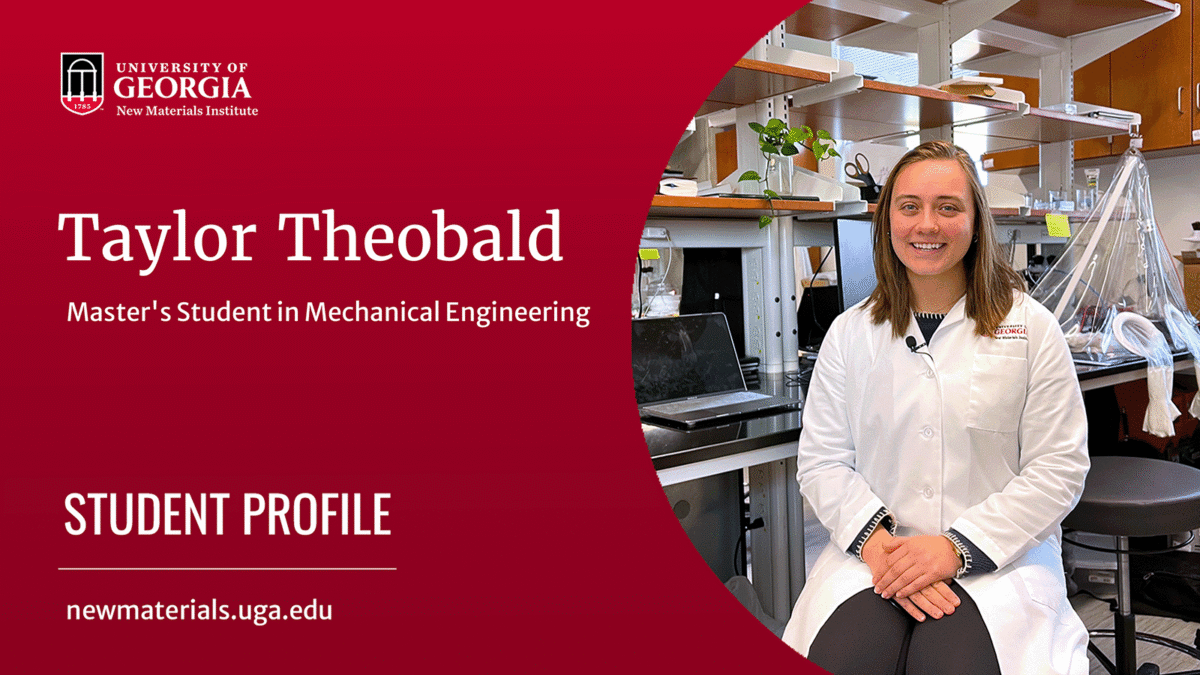
Taylor Theobald recently began her master’s degree program in mechanical engineering under the mentorship of Kenan Song, PhD, an associate professor in the UGA College of Engineering who is faculty member in the UGA New Materials Institute. Song’s Advanced Materials Advanced Manufacturing Laboratory (AMAML), where Theobald conducts her research, focuses on creating advanced materials and manufacturing processes that are sustainable and renewable.
Theobald began working in the Song Lab as an undergraduate at the University of Georgia; she completed her bachelor’s in mechanical engineering in 2025. Her long-term goal is to help the aerospace industry become greener. While she is just starting her graduate work, Theobald has already collected roughly two years in work experiences, through internships and co-op rotations, at companies like Gulfstream Aerospace, where she completed three co-op rotations totaling 12 months, and the National Aeronautics and Space Administration (NASA), where she worked as an intern in their cryogenics program for five months.
She talked to us recently about what she’s learned thus far through her educational experiences, including her work in the Song Lab and UGA New Materials Institute. The above video links to a long video on Taylor Theobold. We’re also providing links to additional videos (see links below). Her full interview is below.
How did you become interested in studying materials science?
I became interested in materials science when I realized it wasn’t just about chemistry—it also has a strong manufacturing and mechanical side. Coming from a mechanical engineering background, I was drawn to the opportunity to understand how materials behave in real-world applications.
Provide some details on your specific area of interest.
My current research focuses on using polyethylene terephthalate, or PET, waste-derived graphene (FJH graphene) as a filler in polymer fibers for sensing applications. I am investigating how incorporating this sustainable nanomaterial can produce polymer fibers with thermal, mechanical, and electrical properties comparable to less sustainable, but commercially available alternatives.
Share a rewarding experience related to your work at the UGA New Materials Institute.
One of the most rewarding experiences was participating in the National Science Foundation’s I-Corps program. This opportunity allowed me to see a product I helped develop in the lab come to life through customer discovery, giving me insight into how materials research translates into real-world applications. Being part of the process from lab-scale development to understanding market needs was incredibly motivating and reinforced the broader impact of my work.
How has your experience with the UGA New Materials Institute influenced your academic trajectory or career goals?
Before joining the New Materials Institute, most of my professional development came through three co-op rotations and three internships, which gave me valuable industry experience but left me uncertain about the exact direction I wanted to pursue long term. Once I began research at the UGA NMI, I realized how transformative materials research could be within the world of sustainability. That experience allowed me to hone my career goals—I want to pursue research and development initiatives within the aerospace industry. But more specifically, I want to bridge the gap between sustainability and aerospace composite materials.
Describe a project or research you’ve worked on related to the UGA NMI.
One of the most meaningful projects I’ve collaborated on related to the New Materials Institute focused on recycling waste glass fibers from wind turbine blades into carbon fiber precursors. This research not only addressed the growing challenge of composite waste but also opened a pathway to create advanced, high-performance fibers for aerospace and other demanding applications. Beyond the technical side, I also served as the entrepreneurial lead for our team in the National Science Foundation’s I-Corps program. That experience gave me the opportunity to explore the commercialization potential of our work, bridging research with real-world application and teaching me how sustainability-driven innovation can move from the lab into industry.
What challenges have you faced in your work and how have you overcome them?
One challenge I faced in my work was learning that experiments don’t always go as planned. Early on, I struggled when unexpected issues disrupted my timeline, which taught me the importance of building schedules with wiggle room and anticipating potential setbacks.
How do you see your work at the UGA New Materials Institute as contributing to global sustainability efforts?
My work at the UGA New Materials Institute contributes to global sustainability efforts by finding new uses for materials that would otherwise end up as waste. By transforming end-of-life products, such as glass fibers or plastics, into advanced composite precursors, we’re not only reducing landfill burden but also creating sustainable pathways for high-performance materials.
What skills have you gained from working at the UGA NMI that you believe will be most valuable in your future career?
I gained hands-on experience with characterization techniques such as Dynamic Mechanical Analysis (DMA) to evaluate mechanical and thermal properties. I used this same instrument during my internship at NASA, and it was very encouraging to know that the instruments I have access to through the New Materials Institute are the very ones being used in lab environments like NASA.
What advice would you give to other students interested in being involved with the UGA NMI?
Get plugged in early! Even a few hours a week can help you explore different aspects of materials research, discover your strengths, and clarify your interests. Take advantage of every opportunity to learn from the team, ask questions, and try new techniques—these experiences will set a strong foundation for your future career.
Is there anything we haven’t asked that you’d like to share with us?
My involvement at UGA extends beyond the UGA NMI. I have completed several industry internships and co-ops, some in labs and others in different roles. Additionally, I participate in the UGA mentorship program as both a mentor and a mentee, and I’m a member of the Small Satellite Research Laboratory at UGA.