
Combining hot melt extrusion, injection molding to streamline ASD tablet production
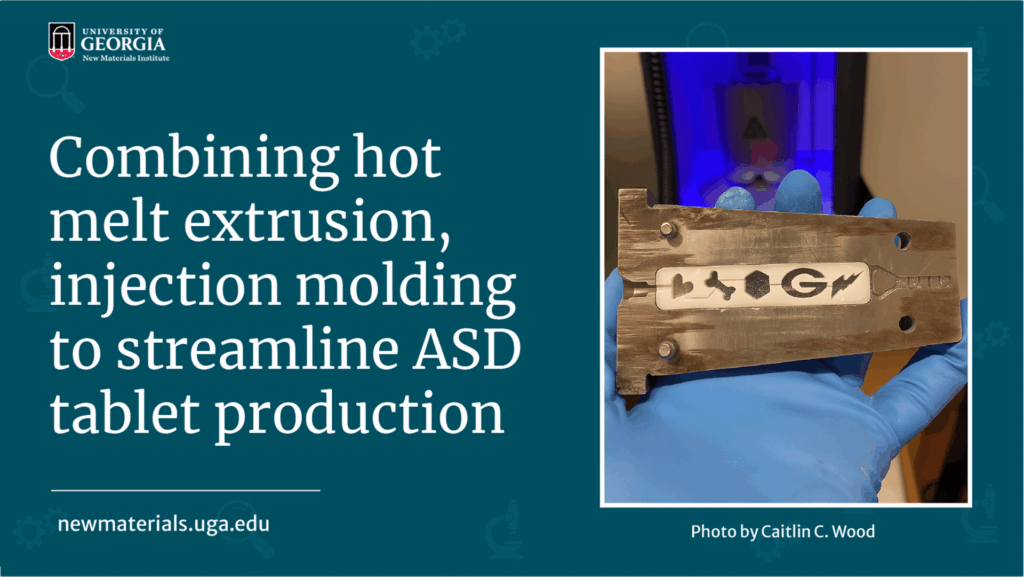
A research team at the University of Georgia New Materials Institute used hot-melt extrusion and injection molding to create immediate release amorphous solid dispersion tablets (ASD), a process normally done in batches. Their novel formulation strategy reduces the multi-step process to two steps, thus decreasing the time and resources needed for manufacturing.
The team used moxidectin, a low dose high potency BCS Class II drug, as the model drug and used polyethylene oxide (PEO) and polyvinylpyrrolidone (PVP) as carriers as well as triethyl citrate (TEC) as a plasticizer. An added benefit of using PEO in pharmaceuticals is its aid in abuse deterrence due to its high impact resistance; PEO makes tablets harder to crush or dissolve for inhalation or injection.
The molds used were created with SLA 3D printing and included both traditional tablet shapes and unique, complex shapes. This can be beneficial for drug identification in medical and pharmaceutical environments. Injection molding is also advantageous for its high precision and homogenous loading.
The study was partially funded by Boehringer-Ingelheim GmbH.
“Development of impact resistant immediate release amorphous solid dispersion via hot-melt extrusion and injection molding” was recently published in the International Journal of Pharmaceutics. Study authors are Caitlin C. Wood, Kush G. Patel, Virginia L. Weber, Adaeze R. Osakwe, Nohora P. Manovacia Moreno, Michael L. Broich II, Joshua C. Bledsoe, Jessica A. Bramhall, Vladislav V. Klepov, Sammy Bell and Jason J. Locklin. Sammy Bell is an adjunct research professor in the UGA New Materials Institute. Vladislav V. Klepov is an assistant professor in the Department of Chemistry in the Franklin College of Arts and Sciences. Jason Locklin serves as head of the New Materials Institute and head of the Department of Chemistry at the University of Georgia. All other co-authors are members of the Locklin Group.