
Study finds indigo is an effective nucleating agent for PHB-co-HHx
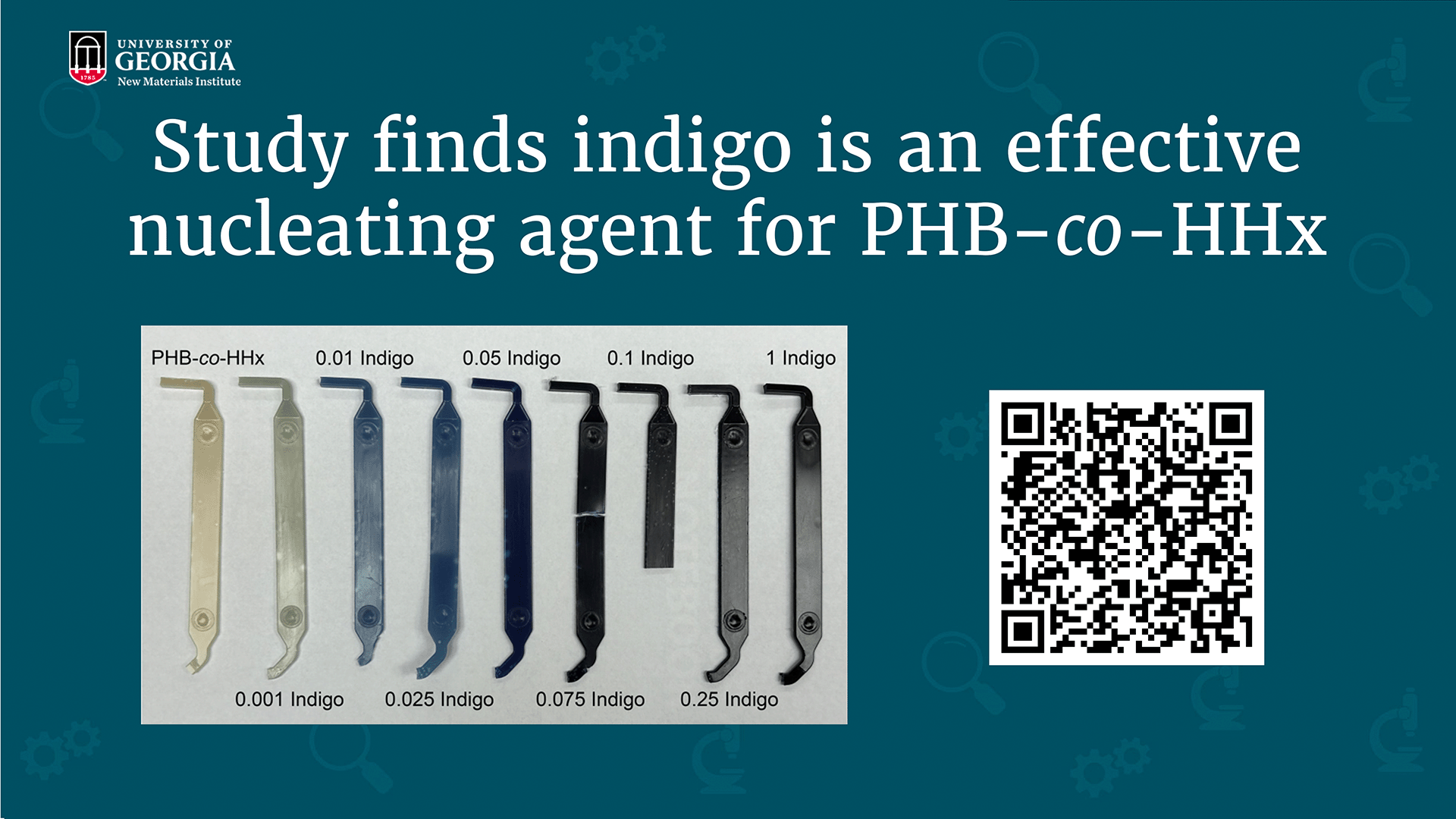
In addition to being a colorant, indigo is an effective nucleating agent for poly(3-hydroxybutyrate-co-3-hydroxyhexanoate), or PHB-co–HHx, and at significantly lower loads than orotic acid, according to a study from the Locklin Group at the University of Georgia New Materials Institute.
In recent years, PHB-co–HHx copolymers have been frequently studied for their potential as sustainable alternatives to traditional plastics. When tailoring these copolymers to meet a desired property, their achievable crystallinity and crystallization rate are both reduced, creating the need for a nucleating agent. No nucleating agent has been found to be as efficient as orotic acid, which is nonmiscible in the PHB–co–HHx melt, thus limiting this pairing to applications where the plastic thickness is about 0.5mm or more.
Two studies published in 2023 from the Locklin Group linked the presence of hydrogen-bonding moieties to effective nucleation of PHB-co–HHx. The first, from Bledsoe, Crane and Locklin, focused on the role of hydrogen bonding; a subsequent study focused on melt solubility and morphology.
The Locklin Group’s latest work examines indigo as a melt-miscible nucleating agent for PHB-co–HHx, blended through melt-extrusion—a crucial high-volume manufacturing process for molded plastics. The team analyzed neat and nucleated samples by differential scanning calorimetry, polarized optical microscopy, gel permeation chromatography, and X-ray diffraction.
The team found indigo to be an effective nucleating agent for PHB-co–HHx, the most favorable nucleating performance at 0.1% concentration—only 10% of the concentration required for orotic acid. This was due to the partial melt miscibility with PHB-co-HHx, which allowed the indigo to self-assemble into fine, well-distributed particles. Similar performance by orotic acid is observed at a 1% concentration.
“Partial Miscibility-Driven Nucleation of Poly(3-hydroxybutyrate-co–3-hydroxyhexanoate) with Indigo Dye” was coauthored by Kush G. Patel, Adaeze R. Osakwe, Graham Fenn, Grant H. Crane, Vladislav V. Klepov, Branson W. Ritchie, and Jason J. Locklin and published recently in the American Chemical Society Applied Polymer Materials journal.