
Crystals that twist like opening seed pods point to new optical technologies
Gallery: Tiny semiconductor crystals that mimic plant seed pods


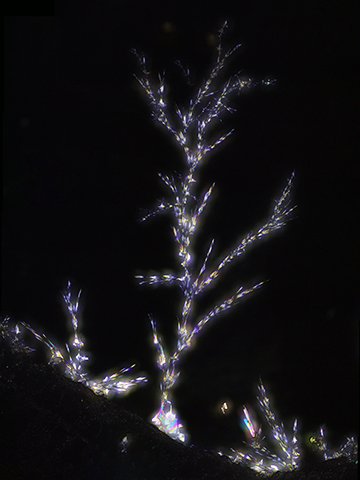


Spontaneous morphological chirality through geometric frustration
Tiny crystals that mimic the chiral opening of seed pods—twisting and coiling into helices as they grow—could open a path to smarter sensors, soft microrobotics, and miniaturized quantum photonics, according to a new study. Just as a seed pod springs open because its mismatched layers of cellulose fibers store and release elastic energy, these two-dimensional crystals are built from stacked, misaligned sheets that pull against one another and cannot lie flat. Unlike a plant, though, the crystals are semiconductors that glow, and their twist is continuously tunable—opening a route to optical technologies that plants cannot access.
Using a layered metal-halide perovskite as a tunable material class, researchers accessed in-plane morphological chirality without any chiral reagents—growing the crystals from just two simple precursors in a water-based solution by designing achiral organic spacers to engineer specific crystallographic symmetry in the inorganic lattice, generating spontaneous morphological chirality through geometric frustration. Geometric frustration is a phenomenon in physics and materials science where the crystal shape is forced by geometry instead of the lowest-energy arrangement, creating disorder and unusual shifting patterns that can be leveraged to create flexible soft materials and customize properties.
The researchers found that twisting crystals built from stacked sheets and lined up from different directions pulled against one another, just like layers in a seed pod. The crystal is unable to lie flat and twists into a variety of shapes as it grows, some wrung out like a towel and others coiled like a spring. The twisting shape originates from how the layers are stacked, which can be designed for predicted shapes and switched off.
Useful for optical sensors, displays and quantum photonics
Spontaneously formed twisted and helical ribbons were confirmed by microscopy, diffraction, and molecular dynamics simulations. The formation of elongated ribbons was a random behavior, the study authors said, and these twisted nanoribbons were described as true single crystals with long-range lattice ordering, in contrast to that observed in ordered attachment of twin domains, doped crystals, or self-assembled amphiphile bilayers.
Future studies should focus on understanding how these organic network structures work in layered perovskites, which is important for tuning mechanical frustration in 2D materials and other systems where competing crystallographic symmetries yield emergent mechanical, optical, or electronic properties, the authors said.
Layered halide perovskites are a relative of materials being developed for solar cells, LEDs, photonics, and quantum information science. Twisted structures respond differently to light making them useful for optical sensors, displays and quantum photonics.
“Geometric Frustration in Morphologically Chiral Nanoribbons of Layered Perovskites” was coauthored by Wenhao Shao* of the University of Georgia; Zhichen Nian* of the University of Notre Dame; Yuan Lu and Yi Yu of ShanghaiTech University; Hanjun Yang of Purdue University; Brett M. Savoie* of the University of Notre Dame; and Letian Dou* of Emory University. This work was supported by the U.S. Department of Energy Office of Basic Energy Sciences under award number DE-SC0022082 and U.S. National Science Foundation under award number 2539855-DMR, with additional support from the Research Instrumentation Center at Purdue University.
Contact corresponding authors
Corresponding authors on this paper can be reached at swh@uga.edu and letian.dou@emory.edu.
*Shao, Nian, Savoie and Dou are previously from Purdue University.
— written by Kat Yancey Gilmore